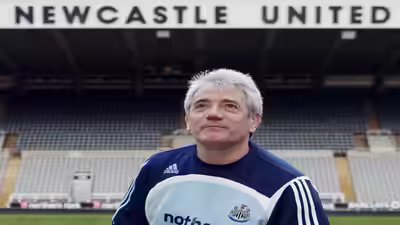
![<p>Announcement from Newcastle United</p>
<p>” msid=”132520210″ width=”” title=”” placeholdersrc=”https://static.toiimg.com/photo/83033472.cms” imgsize=”” resizemode=”4″ offsetvertical=”0″ placeholdermsid=”47529300″ type=”thumb” class=”” src=”https://static.toiimg.com/photo/msid-132520210/ltpgtnewcastle-united-postltpgt.jpg” data-api-prerender=”true”/></p></div>
</div>
<p><span class=]()
A two-time Ballon d’Or winner, Keegan enjoyed a glittering playing career that saw him captain England, win the European Cup with Liverpool and become one of only four Englishmen to win football’s most prestigious individual honour.
In addition to his achievements on the field, Keegan became a cultural icon during the 1970s. His signature permed hairstyle inspired footballers across Europe, while his celebrity status extended to television, music and advertising. He released the single “Head Over Heels in Love”, appeared in an aftershave commercial alongside heavyweight boxing great Henry Cooper and made regular appearances on television.
Keegan was also among the first prominent English footballers to move abroad when he left Liverpool for German club Hamburger SV in 1977 after winning the European Cup.
“For the Hamburg fans, he will first of all remain a favorite of the audience, an exceptional player and one of the best football players who ever wore a rhombus (coat of arms) on his chest,” said the Bundesliga club.
His trip to Germany proved extremely successful. Keegan won the Ballon d’Or in 1978 and 1979 while at Hamburg, helping the club lift the Bundesliga title in 1979 before reaching the 1980 European Cup final, where they were beaten by Nottingham Forest.
“Hamburger SV will always cherish the memory of their former championship-winning player and two-time Ballon d’Or winner,” the German club added.
Born in Doncaster on 14 February 1951, Keegan began his professional career with Scunthorpe before joining Liverpool in 1971. Under legendary manager Bill Shankly, he formed a prolific attacking partnership with John Toshack, helping the Reds secure a league and UEFA Cup double in 1973.
During his six-year stay at Anfield, Keegan won three league titles, the FA Cup, two UEFA Cups and the club’s first European Cup in 1977. In that final against Borussia Monchengladbach, he won a penalty which Phil Neal converted in Liverpool’s 3-1 victory.
“His legacy in Liverpool will remain etched in history forever,” the club said. “He was considered a hero wherever he went.”
After returning to England from Germany, Keegan joined Southampton, where he finished as League One’s top scorer with 30 goals in the 1981–82 season. before moving to Newcastle United, a club he supported through his father.
His tireless work rate and infectious personality quickly made him a fan favorite at St James’ Park before he retired in 1984. He returned to action briefly the following year for two away appearances with Australian side Blacktown.
On the international stage, Keegan scored 21 goals in 63 appearances for England. He captained the national team at Euro 1980 and represented his country at the 1982 FIFA World Cup, his only appearance at football’s biggest tournament after England failed to qualify for the 1974 and 1978 editions.
Keegan later enjoyed a memorable managerial career that spanned from 1992 to 2008. His greatest achievement on the touchline came at Newcastle, where he guided the club from League Two to the brink of the Premier League title in 1995-96.
That campaign became famous both for Newcastle’s attacking football, which earned them the nickname “The Entertainers”, and for Keegan’s emotional televised outburst aimed at
Manchester United manager Alex Ferguson.
“You can tell him now, we’re still fighting for this title. And he’s got to go to Middlesbrough and get something. And I’ll tell you…honestly…I’ll love it if we beat them, I love it,” Keegan said.
Despite leading the table by 12 points in February, Newcastle eventually finished four points behind Ferguson’s Manchester United.
Keegan also manages Fulham, England and Manchester City. His spell as England manager lasted from 1999 to 2000 and ended with a 1-0 defeat to Germany in a World Cup qualifier at the old Wembley Stadium. He is known to have informed Football Association officials of his resignation during an emotional conversation inside the toilet bowl.
He returned to Newcastle for a second time in 2008, but resigned after nine months after falling out with club owner Mike Ashley. He never returned to management, instead staying involved in football through television pundits.
Keegan leaves behind a lasting legacy as one of England’s greatest footballers, a pioneering Ballon d’Or winner, an unforgettable manager and one of the most charismatic figures in sport.