








Most engineering students dream of finding a good job after graduation. Vimal Govind MK, Rashid K, Arun George and Nikhil NP are no exception. They studied together at MES Engineering College in Kerala and upon graduation planned to build successful careers and enter the corporate world like countless young engineers in India. But a tragic event changes everything, and ultimately their lives.Today, the four founders are listed on Forbes Asia’s Under 30 list in the industry, manufacturing and energy categories. Their startup, Genrobotics, makes Bandicoot, India’s first-of-its-kind manhole cleaning robot that helps eliminate the need for humans to enter toxic sewers. Their journey from engineering students to award-winning innovators begins not in the lab, but with heartbreaking news stories they can’t ignore.
A tragedy they can’t forget
In 2015, three people died in a manhole in Kozhikode, Kerala. Two city workers entered the drain to clear the blockage and became trapped inside. A tricycle driver stopped to help, climbed into the manhole, and did not come out.The incident had a profound impact on the four students.

Four engineering students – Vimal Govind MK, Rashid K, Arun George and Nikhil NP – are from MES College of Engineering, Kerala. (Picture: X post)
Rashid K later recalled that before that, they barely knew what a manhole system was because there was no manhole system in their village. But as they learned more about the accident, they realized it wasn’t an isolated incident. Across India, manual scavenging continues despite being banned since 1993. Workers still enter sewers filled with toxic gases such as hydrogen sulfide, methane and ammonia, often without protective equipment or safety measures.Many belong to marginalized communities and generations of families remain trapped in the same dangerous occupations. Four students came to a simple but powerful conclusion: If technology can send machines into factories, space and the deep sea, why are humans still being sent into toxic sewers?Instead of continuing the story, they decided to build a solution.
From steady job to building life-saving robots
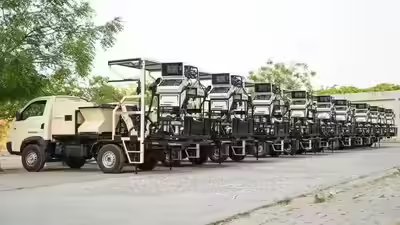
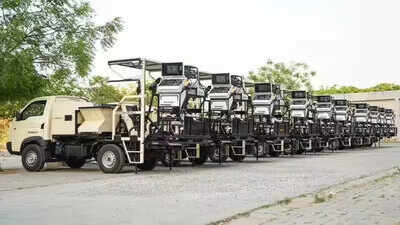
After graduation, all four founders accepted corporate jobs. But the question never left their minds.When the Kerala government invited innovators to develop a robot to replace manual scavenging in 2017, they made a bold decision. They quit their jobs and returned to Kerala to work on solving one of India’s oldest and most neglected challenges.The result is Bandicoot – a 50kg robot designed to clean manholes without the need for humans to enter.The spider-like robot lowers itself into a manhole, uses retractable legs for stability, and uses a 360-degree robotic arm to remove sludge and solid waste. Tasks that once took multiple workers nearly two hours to complete can now be completed in about 45 minutes.But perhaps the greatest achievement isn’t the machine itself.Many sanitation workers who once risked their lives by entering manholes are now trained to operate Bandicoot safely from the ground. Those who once worked in life-threatening conditions are now controlling advanced robotics, marking a shift not only in engineering but also in dignity, safety and opportunity.
Change the city – change the mentality
Bandicoot’s influence has grown steadily over the years. Indian Prime Minister Narendra Modi launched Bandicoot 2.0, and the robots are now deployed in 22 states in India and four other countries.Cities are increasingly adopting robotic sewer cleaning technology. For example, Bengaluru, through the Bangalore Water Supply and Sewerage Board (BWSSB) and Bruhat Bengaluru Mahanagara Palike (BBMP), has introduced artificial intelligence robotic systems to inspect, monitor and clean sewer networks without exposing workers to hazardous conditions. High-resolution cameras, sensors and robotic inspection systems are helping municipalities detect blockages and maintain underground infrastructure more safely and efficiently.This transformation also became symbolic. The Indian government has officially replaced the word “manhole” with “machine hole,” reflecting a larger vision that dangerous sewer cleaning should be done by machines rather than people.For Vimal Govind MK, Rashid K, Arun George and Nikhil NP, the biggest reward is not just being recognized by Forbes Asia Under 30 or seeing their innovations adopted in India. As we all know, an accident that once claimed the lives of three people inspired a solution that could help prevent more such tragedies in the future.Their stories remind us that some of the world’s most meaningful innovations didn’t start with billion-dollar ideas or cutting-edge laboratories. Sometimes they start with four engineering students who simply refuse to accept that an avoidable tragedy can happen again.Disclaimer: This article is for informational purposes only and is based on public reports and statements regarding the founders of Genrobotics, the development of Bandicoot, and the deployment of robotic sewer cleaning technology in India. Deployment, adoption and operational details may vary by city and government agency. Readers are advised to refer to official sources for the latest information.