








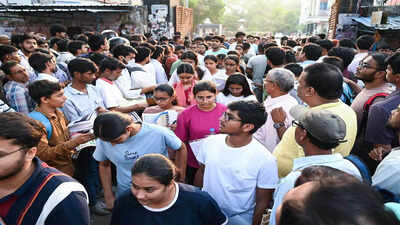
With over 2.2 million candidates appearing for the NEET-UG 2026 re-examination on Sunday, Prime Minister Narendra Modi postponed departure from Delhi airport to avoid traffic jams that would affect students heading to the exam centre.The Prime Minister reportedly arrived at the airport at around 1.15pm but chose to wait until checks began at 2pm. The decision was taken to ensure students traveling to centers across the National Capital Region do not face additional transportation disruptions caused by high-alert convoy movements.The move comes on a day when thousands of aspiring medical students are attempting one of the most important tests of their lives. The NEET-UG 2026 re-examination is underway after the National Testing Agency (NTA) canceled the exam scheduled for May 3 due to allegations of question paper leakage.
Students become the center of attention
The retest has drawn national attention after weeks of controversy surrounding the integrity of the exam process. For candidates, Sunday represents a second chance after months of preparations were thrown into uncertainty by the cancellation of previous exams.In this context, ensuring that students reach the centers in a timely manner becomes a top priority. The Prime Minister’s decision to delay leaving office is seen as an attempt to prevent any disruption during a critical reporting period.Union Minister Sukanta Majumdar praised the initiative and described it as an example of responsibility and care towards citizens, especially students appearing for high-stakes national examinations.
Review of large-scale security inspection operations
The National Examinations Agency has launched one of the largest ever security arrangements for national entrance exams to ensure re-examinations go smoothly.Candidates will be admitted only after strict body-search procedures, including metal detector checks. The examination room is equipped with CCTV surveillance and has installed electronic signal jammers provided by government agencies to prevent digital misconduct.Each examination room is monitored by two invigilators, and more than a dozen officials are deployed at each examination room to supervise the conduct of the examination.
Thousands of people deployed across the country
To enhance security, the IRS deployed 38,795 search agents and 48,448 biometric agents for facial authentication and verification. Around 6,700 observers and more than 100 virtual observers are also monitoring the examination process.On average, each examination room is equipped with 40 to 50 security personnel.The authorities also involved the police force, paramilitary forces, the Indian Air Force and the Postal Department in the transportation and protection of confidential examination materials, underscoring the scale of the operation.
Candidate welfare measures
Apart from security arrangements, special provisions have been made for the welfare of the candidates. The center is equipped with drinking water facilities, ORS, ambulance, shaded waiting area and seating arrangements for parents accompanying students.Additional blank sheets and wall clocks are also provided, while additional time has been added during the entry process for enhanced security checks.More than 2.2 million candidates took the exams and authorities hope the wide-ranging arrangements will help restore confidence in exams which have faced unprecedented scrutiny this year. On a day where concerns about fairness and smooth conduct were dominant, the Prime Minister’s decision to delay departure added a symbolic message: ensuring students arrive at exam centers on time is a priority.